
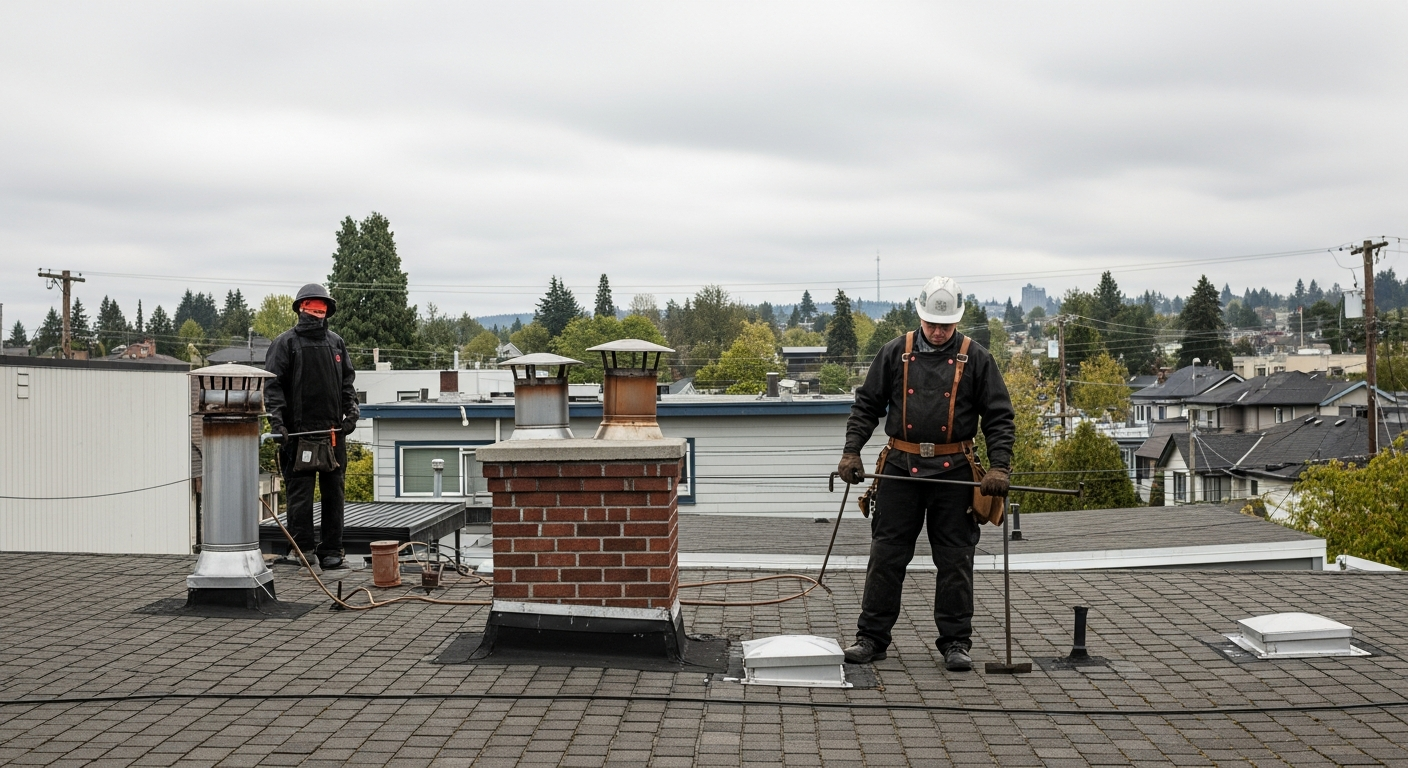
Most Seattle-area homeowners who burn wood should have their chimney swept at least once a year, and twice if they use the fireplace more than three nights a week during the heating season. Gas appliance flues need inspection annually but typically require cleaning less frequently. Washington State adopts the International Fire Code, which references NFPA 211—the national standard that triggers a cleaning whenever deposits reach 1/8 inch of buildup, regardless of how many fires you've had.
Why the Pacific Northwest Changes the Calculus
Seattle's climate is not a neutral variable. Persistent moisture from October through April does two things to a chimney: it accelerates the conversion of creosote from a loose, brushable deposit into a hard, glazed form (called third-degree or glaze creosote), and it promotes moss and algae growth on masonry crowns and caps that can trap even more water. A chimney that would need one annual sweep in Denver may genuinely need two in Ballard.
Wood burned in the Pacific Northwest also tends to be Douglas fir, alder, or big-leaf maple—species that are widely available but burn at different efficiency levels. Alder is relatively clean-burning; fir burned before it has fully seasoned (which takes 12–18 months of split, covered storage in our wet climate) produces far more creosote per cord than dry hardwood.
An Illustrative Scenario
*The following is a hypothetical teaching example, not a real customer account.*
Edward, a homeowner in Phinney Ridge, burns his wood-insert fireplace four or five evenings a week from November through March—roughly 80 fires per season. He buys a cord of fir from a roadside seller every fall, sometimes still damp. By February, a sweep finds a thick layer of stage-two creosote (crunchy, tar-like flakes) and the beginning of glaze creosote near the smoke chamber. Had Edward waited until the following autumn for his first cleaning, that glaze would have been much harder to remove and, in a worst case, fuel for a flue fire. His usage and wood quality put him firmly in the "twice a year" category.
Sweep Frequency by Fuel Type and Usage
| Situation | Minimum Sweeps / Year | Notes |
|---|---|---|
| Wood fireplace or insert, light use (< 2 nights/week) | 1 | Inspect for moisture damage at same visit |
| Wood fireplace or insert, moderate use (2–4 nights/week) | 1–2 | Time second sweep mid-season if burning unseasoned wood |
| Wood fireplace or insert, heavy use (> 4 nights/week) | 2 | First sweep before heating season; second sweep in January–February |
| Pellet stove | 1 | Clean burn, but ash and clinker buildup still requires annual attention |
| Gas fireplace or gas insert | 1 inspection; cleaning as needed | Mainly checking for blockages, liner cracks, bird nests |
| Oil furnace flue (older homes in Seattle) | 1 | Sulfur deposits; annual cleaning is code-expected |
Typical Seattle sweep costs run $150–$300 for a standard wood-burning flue; a mid-season second sweep at many companies runs $100–$200 if bundled with the annual appointment. See What a Chimney Inspection Should Cost in Seattle (2024 Guide) for a full cost breakdown.
What Washington State Actually Requires
Washington does not set a universal statewide sweep schedule by calendar date. Instead, WAC 51-54A (Washington's adoption of the International Fire Code) incorporates NFPA 211 by reference. NFPA 211 states that chimneys, fireplaces, and vents shall be examined at least once a year and cleaned if deposits reach 1/8 inch. Practically, this means: if a certified sweep measures 1/8 inch or more of buildup at any point in the flue, cleaning is no longer optional under the standard—it is required before continued use.
Some jurisdictions in King and Snohomish counties may have additional requirements tied to building permits for new appliances, but the 1/8-inch / annual-inspection rule is the baseline that applies region-wide.
The Moisture Factor Seattle Sweeps Know Well
Chimney technicians working in the Puget Sound area consistently flag two local patterns worth knowing:
- Shoulder-season fires are higher-risk. A slow, smoldering fire on a cool October evening—before the flue has warmed fully—condenses more creosote per hour than a hot fire in January when the masonry is already warm.
- Cap and crown condition matters more here. A cracked crown lets rain enter the flue, converting dry creosote deposits into a wet, acidic sludge that is corrosive and harder to remove. If your sweep mentions crown damage, take it seriously. See Signs Your Chimney Needs Relining: A Seattle Homeowner's Guide for related warning signals.
How to Choose a Sweep
A qualified sweep in Washington should hold a Chimney Safety Institute of America (CSIA) Certified Chimney Sweep credential or equivalent. Before booking, ask whether the technician will provide a written condition report and photos—standard practice for any legitimate company. Our site evaluates local companies on eight public measures including license and insurance verification, technician credentials, and complaint history; you can review the ranking to compare options without relying on paid search results.
For a complete list of the right questions to ask before you hand over a deposit, see Questions to Ask Before Hiring a Chimney Company in Seattle.
Quick Reference: When to Schedule
- Best time for most Seattle households: Late August through September, before the heating season begins and before sweeps' schedules fill.
- Second sweep (if needed): January or February, mid-season, so you enter the back half of heating season with a clean flue.
- After any chimney fire or storm damage: Immediately, regardless of when you last had service.
Frequently asked questions
- Does Washington State law require an annual chimney sweep?
- Washington adopts NFPA 211 through its fire code, which requires an annual inspection and cleaning whenever deposits reach 1/8 inch. There is no separate state law mandating a sweep on a fixed calendar schedule, but the 1/8-inch threshold means most wood-burning households in the Seattle area will need at least one cleaning per year.
- How often should a gas fireplace flue be swept in Seattle?
- Gas flues produce far less residue than wood-burning appliances, but they still need an annual inspection. Cleaning is done as needed—typically every few years unless a blockage (such as a bird nest or debris) is found. Annual inspection is still considered the minimum under NFPA 211.
- Does Seattle's wet climate mean I need more frequent chimney sweeping than in drier parts of Washington?
- Yes, in practical terms. High year-round moisture accelerates the hardening of creosote into harder-to-remove glaze creosote, promotes moss growth on masonry, and increases crown cracking. Most CSIA-certified sweeps working in the Puget Sound area recommend erring toward the more frequent end of any frequency range for this reason.