
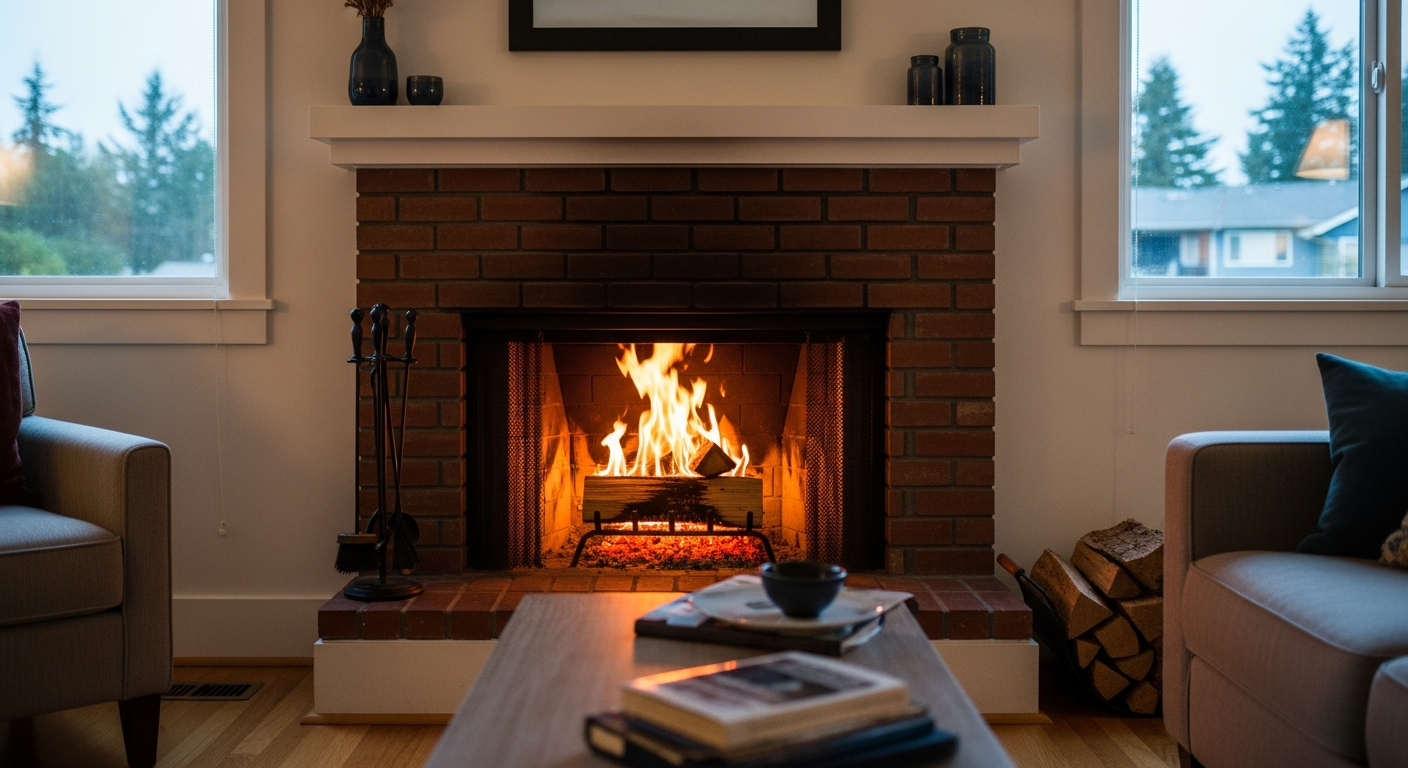
Washington homeowners with a wood-burning fireplace should budget for an annual sweep and inspection — typically $150–$300 in the Seattle area — plus the real possibility of creosote-related repairs. Gas fireplace owners face lower routine costs but still need a yearly inspection to stay safe and compliant with most homeowner insurance policies. Neither system is truly maintenance-free in the wet Pacific Northwest climate.
Why Washington's Climate Changes the Calculation
The Puget Sound region brings a particular maintenance challenge: high annual rainfall, mild but damp winters, and moss-prone rooflines. Moisture accelerates mortar deterioration, promotes rust on dampers and fireboxes, and — in wood-burning systems — causes creosote to become stickier and harder to remove. A fireplace that would need moderate upkeep in a dry climate may need more attention here.
An Illustrative Scenario
Consider Marcus, a hypothetical homeowner in Renton who bought a 1988 house with both a gas insert in the living room and a traditional masonry wood-burning fireplace in the basement. When he calls for an inspection on both, the technician finds that the wood flue has Stage 2 creosote buildup — the dense, tar-like form — after two seasons of burning green wood. The gas insert, meanwhile, has a corroded burner port and a thermocouple nearing the end of its service life. Neither problem was visible from inside the house. Marcus's scenario is purely hypothetical, but it mirrors the pattern inspectors see regularly in older Seattle-area homes: deferred maintenance on one system, and an assumed-fine gas unit that hasn't been serviced in years. It illustrates why the fireplace type doesn't determine whether you need annual service — it determines what that service looks like.
What Each System Actually Needs
Wood-Burning Fireplaces
Wood systems produce creosote, a flammable byproduct of incomplete combustion. The National Fire Protection Association (NFPA 211) recommends an annual inspection and cleaning as needed. In practice, most Seattle-area chimney professionals recommend sweeping every cord of wood burned, or at minimum once per heating season. The damp Pacific Northwest climate means many homeowners burn more softwood than is ideal — fir and pine are common — which produces creosote faster than seasoned hardwoods.
Key annual tasks: - Creosote sweep and flue inspection - Damper function check - Firebox and smoke shelf inspection - Cap and crown inspection (critical given Seattle rainfall) - Flue liner integrity check — if you see cracks or gaps, review Signs Your Chimney Needs Relining: A Seattle Homeowner's Guide before your next burn season
Gas Fireplaces and Inserts
Gas systems don't produce creosote, but they are not maintenance-free. Combustion byproducts still pass through the flue or direct-vent termination, spiders and insects can nest in gas orifices over summer, and the mechanical components — thermocouples, gas valves, igniters, blower motors — degrade over time. Washington Gas (Puget Sound Energy) service territory requires appliances to be maintained per manufacturer specifications to preserve warranty and, in many cases, insurance coverage.
Key annual tasks: - Burner and pilot assembly cleaning - Thermocouple and thermopile testing - Glass panel inspection and gasket seal check - Vent termination inspection for blockage or corrosion - Carbon monoxide detector functionality confirmation
Cost Comparison: Typical Seattle-Area Ranges
The figures below are typical ranges observed in the greater Seattle and Puget Sound market. Your actual cost will vary based on access, system age, and findings at inspection. For a deeper look at inspection pricing, see What a Chimney Inspection Should Cost in Seattle (2024 Guide).
| Service | Wood Fireplace | Gas Fireplace / Insert |
|---|---|---|
| Annual inspection (Level 1) | $150–$250 | $100–$200 |
| Sweep / cleaning | $100–$175 (add-on) | $75–$125 (add-on) |
| Damper replacement | $200–$500 | $150–$400 |
| Flue relining (if needed) | $2,500–$5,500 | $1,500–$3,500 |
| Creosote treatment (Stage 2) | $200–$600 | N/A |
| Thermocouple / thermopile | N/A | $100–$250 |
| Cap replacement | $150–$350 | $100–$300 |
All ranges are typical estimates for the Seattle metro area and should not be treated as quotes.
Safety Steps No Washington Homeowner Should Skip
Carbon monoxide detectors are non-negotiable for both systems. Washington State law (RCW 19.27.530) requires CO alarms in residential dwellings with fuel-burning appliances. Replace detector batteries annually and replace units every 5–7 years per manufacturer guidance.
Burn only seasoned, dry wood. Green or wet wood accelerates creosote buildup dramatically. Wood should be split and dried for at least 12 months; moisture content should be below 20 percent, measurable with an inexpensive wood moisture meter.
Never assume the previous owner maintained the system. When buying a home in Washington, treat a fireplace inspection as part of your due diligence, not an optional upgrade. Before you hire anyone, Questions to Ask Before Hiring a Chimney Company in Seattle is worth reading first.
Verify license and insurance. Washington State requires chimney sweeps to hold a contractor's license (L&I). Ask for the license number before scheduling — this is one of eight factors used in the ranking on this site.
Choosing the Right Service Interval
For wood systems, once per heating season is the floor, not the ceiling. Heavy users — more than two to three fires per week from October through March, which is realistic in a Seattle winter — should consider sweeping mid-season as well. For gas systems, once per year before the heating season begins is the standard recommendation, even for lightly used units. A system that sat unused for a summer in a damp climate is exactly the environment where insects nest and seals deteriorate.
Both fireplace types reward consistent, modest annual spending over deferred maintenance that turns into a large repair or, worse, a house fire.
Frequently asked questions
- Does a gas fireplace in Washington really need annual maintenance if I barely use it?
- Yes. Even lightly used gas fireplaces need a yearly inspection. Over a damp Pacific Northwest summer, insects can nest in burner orifices, vent terminations can corrode, and mechanical components like thermocouples degrade regardless of use. Most homeowner insurance policies also require that fuel-burning appliances be maintained per manufacturer specifications.
- How much does a wood fireplace sweep cost in Seattle?
- A combined inspection and sweep typically runs $200–$400 in the greater Seattle area, depending on system condition, flue height, and access. Inspection alone (Level 1) is usually $150–$250. If the technician finds Stage 2 or Stage 3 creosote, additional treatment costs $200–$600 or more on top of the basic sweep.
- Is creosote more of a problem in the Pacific Northwest than in other regions?
- It can be. The Seattle area's damp climate leads many homeowners to burn wood that isn't fully seasoned, which produces more and stickier creosote. Burning softwoods like fir or pine — common in the region — also generates creosote faster than hardwoods. Annual sweeping and burning only dry, seasoned wood are the most effective countermeasures.